
Amherst Projected Versus Actual Release
A projected date is a calculation based on the sentence information, credit rules, and custody facts known at that time. VADOC public material describes a release date in its locator, while the current NAAVI offender detail uses the label Projected Release Date. The label can vary by interface and record. It should always be read as an estimate until the responsible authority completes its final checks.
An actual release is an event. VADOC distinguishes an advance notice about an anticipated date from its notice that a person is no longer in VADOC custody. Signed paperwork, an updated custody or supervision record, and agency confirmation are stronger evidence that the event occurred. A person may also leave incarceration for parole yet remain under state authority in the community.
A pretrial person at Amherst County Adult Detention Center has no earned-time date. Release depends on bond, a court order, dismissal, or another lawful basis, plus the absence of another hold. A transfer to VADOC, another jail, USMS, or ICE ends the Amherst booking location but does not mean community release.
Find an Amherst Release Date
The correct route turns on sentence responsibility. VADOC calculates an active state-responsible Earned Sentence Credit sentence longer than twelve months. Local authorities may calculate a shorter local term. BRRJA can confirm what it maintains for an ACADC booking, but jail staff should not be asked to explain a state calculation owned by VADOC.
- Check the criminal case and sentencing order. Confirm whether the person is pretrial, locally sentenced, or state responsible.
- For state custody or supervision, search the VADOC Inmate and Supervisee Locator by seven-digit DOC ID or by the required name fields.
- Compare identity, status, facility, and any displayed release-date field. VADOC says the locator is updated daily but may be inaccurate or old.
- For a local Amherst sentence, contact ACADC at 434-528-3160 and obtain the court order. Ask which authority owns the computation.
- When documentary proof is needed, request the computed date and relevant release record from VADOC or BRRJA, based on responsibility.
- After the date passes, verify actual release, transfer, or community supervision rather than relying on the old forecast.
The Amherst County released-inmate workflow also checks the court, receiving custody system, and regional-jail record. Those channels are detailed in the Amherst County release search. A current roster is useful for current custody, not as a historical release-date archive.
Note: A missing roster name does not supply a date or reason, and a future locator date does not confirm release.
Virginia Credits Shape Amherst Dates
Virginia uses more than one credit regime. VADOC describes Good Conduct Allowance sentences as generally tied to felony offenses before January 1, 1995 and misdemeanors before July 1, 2008. For active GCA terms or combinations longer than twelve months, the state computes the relevant parole and good-time dates. A GCA class can range from zero to thirty credit days per thirty served under the applicable rules. The maximum must never be assumed for one person.
Earned Sentence Credit applies to felony offenses on or after January 1, 1995. For offenses listed in Code § 53.1-202.3(A), the stated maximum is 4.5 days per thirty served, subject to class and prerequisites. Eligible offenses under subsection B use a four-level structure, with Level I allowing fifteen days per thirty. Program participation, cooperation, conduct, offense eligibility, and earning class all matter.
The common phrase serve eighty-five percent is only shorthand. At 4.5 credit days per thirty served, the arithmetic share is about 86.96 percent when the maximum rate applies. Other current credit rates differ. Most post-1994 felony sentences also are not ordinary discretionary-parole sentences, but exceptions exist. The actual Amherst projected release date must come from the responsible authority's case-specific computation, not a broad percentage.
Good-time language should be tied to the offense date and sentence type. A GCA class is not the same as an ESC level, and a maximum statutory rate is not a personal award. VADOC identifies total sentence, presentence credit, the applicable credit scheme, earning class, program participation, and disciplinary history as parts of the computation. Court corrections or new commitments can then change the starting data. That is why two people with terms of the same stated length may have different Amherst projected release dates without an error in either record.
Credits can be forfeited and, in some circumstances, restored under the governing structure. The public locator does not explain each arithmetic input. A focused VADOC record request should identify the person and DOC ID and ask for the existing computed date, sentence type, credit information available for disclosure, and release or discharge documentation. Confidentiality limits apply, so no request should promise access to the complete corrections file.
Local time is separate. An Amherst court may award jail credit, and BRRJA applies the policy relevant to a local term, but a pretrial bond release is driven by bond satisfaction and holds rather than sentence credits. A state-responsible person at ACADC can remain under VADOC computation even though the person has not yet moved to a state prison. Responsibility must be settled before applying any chart.
The official VADOC time-computation page shows the state framework and credit categories:
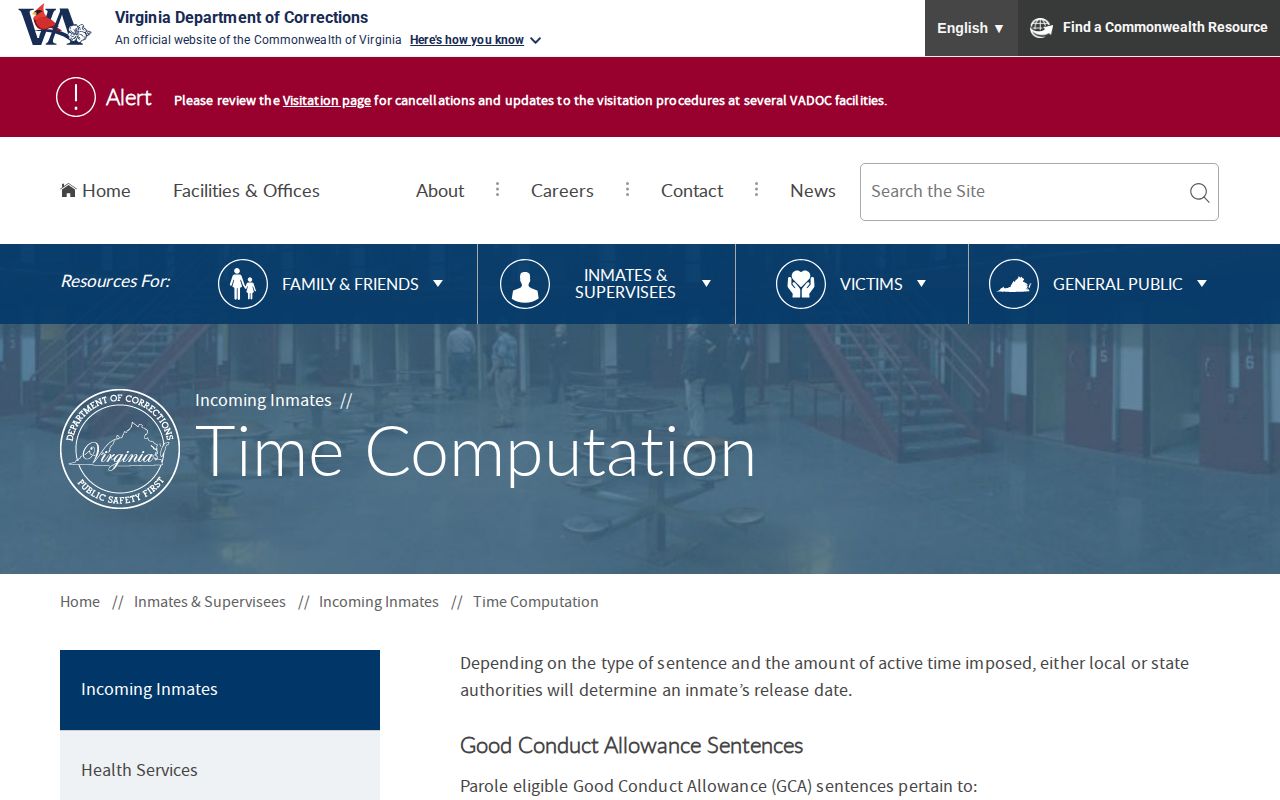
The page is the right starting point for state terms, but a public chart cannot replace review of a person's orders, credits, and holds.
Why Amherst Release Dates Move
VADOC records staff must reconcile more than a sentence end date. Operating Procedure 050.3 calls for checks of the electronic and hardcopy record, warrants, detainers, court orders, discipline and classification issues affecting time, and uncalculated sentences. One change can move the date or change where the person goes.
| Factor | Possible effect | Record to check |
|---|---|---|
| Presentence jail credit | Changes credited time already served | Court order and time computation |
| Credit class or conduct | Changes earned-credit pace or causes loss/restoration | VADOC computation and discipline record |
| Corrected or new order | Changes sentence terms or adds active time | Signed court order |
| Detainer or warrant | May prevent community release or cause transfer | Agency confirmation and release review |
| Parole decision | May alter the path for an eligible sentence | Board report plus VADOC release record |
| Uncalculated sentence | Delays final authorization | VADOC records review |
Under Code § 53.1-28, the VADOC Director has limited authority to discharge a state prisoner within the statutory period before the ordinary term end for a prerelease purpose. It is not a promise of automatic early release. The same law addresses action when an improper release is discovered.
Confirm Amherst Actual Release
Use the notification channel that matches custody. Virginia Jail VINE covers local and regional jail events for an Amherst-linked person, while VADOC state-prison victim notifications use NAAVI. A local VINE out-of-custody event may still be a transfer. Eligible NAAVI users may receive an advance notice and an actual-release notice, but the advance date can change.
For VADOC custody, the facility-release process explains final paperwork and discharge steps:
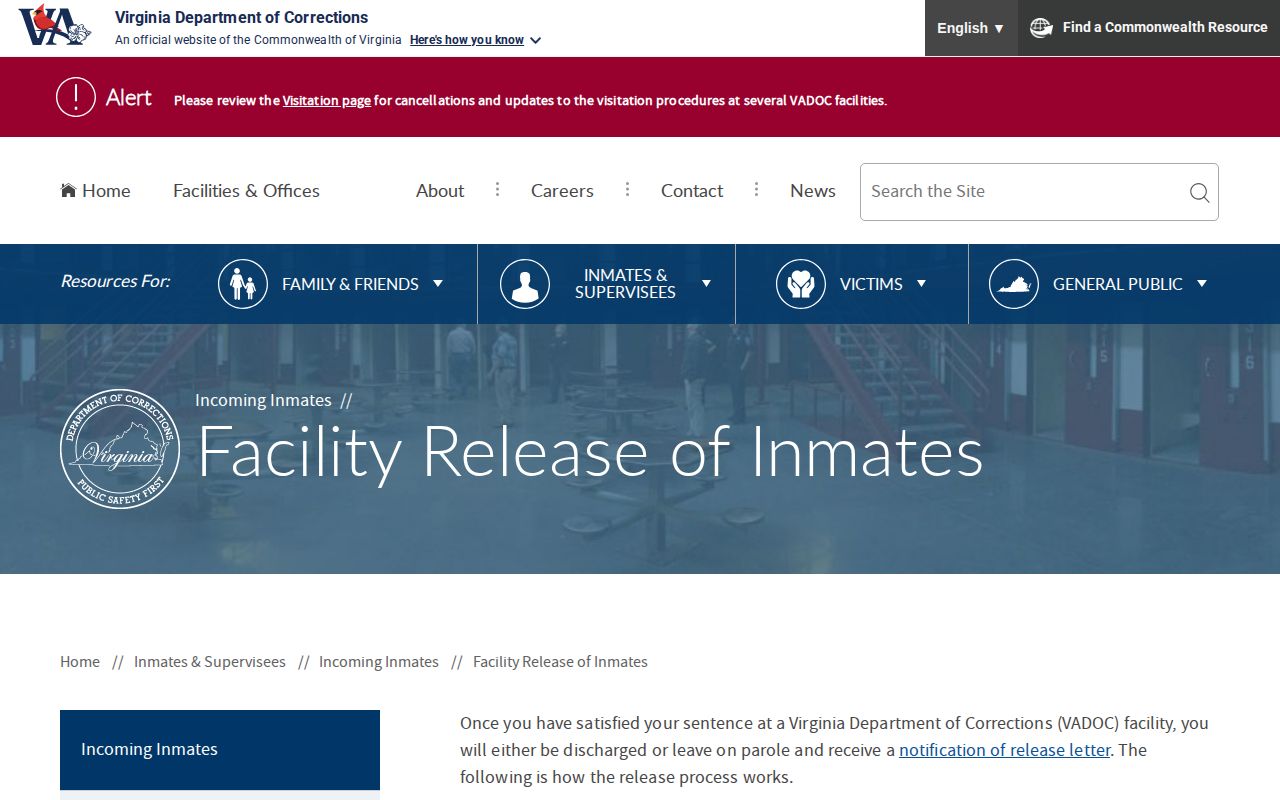
The state process includes final authorization and documents. It applies to VADOC releases, not a promise about the time or exit used by the regional Amherst jail.
Confirm a local event with BRRJA and the Amherst court record. Confirm a state event with VADOC and, when applicable, District 13 supervision data. A federal or immigration transfer requires the receiving system. The Amherst VINELink inmate search explains the local-alert route and the separate NAAVI channel.
Release-day documents matter after the forecast. VADOC states that the applicable discharge or parole papers are read, signed, dated, and witnessed. Staff also address property, funds, medication, and transport in the state process. Those steps help show that authorization moved from a calculated date to an actual event. They do not describe ACADC procedure, because BRRJA has not published a matching local release protocol. For an Amherst jail discharge, request the BRRJA date, time, authority, type, and destination fields, then compare them with the court order. For a state release into supervision, compare the signed papers with the District 13 entry. If the person instead transfers, record the receiving agency and continue the search there.
A notification can arrive before all public screens update. Save the event date and agency name, but never treat a message alone as proof of the release reason. A direct records check resolves whether the person entered the community, began parole, reported to probation, or remained confined elsewhere.
Who Computes Amherst Release Dates
The authority follows the sentence, not just the building. A state-responsible person can be physically housed at ACADC while VADOC computes the state term. A short local sentence may be calculated locally. Bond and pretrial release follow the court and hold status, not an earned-credit chart. This is the distinctive Amherst calculation issue: BRRJA and VADOC can touch the same person's custody path while owning different records.
Ask a narrow question. Identify the booking, sentencing court, active time, and whether VADOC has accepted state responsibility. Then direct computation questions to that authority. Do not mix a VADOC projected date with BRRJA's release time, and do not import a state-facility release-day policy into ACADC. The regional jail publishes no fixed release time or weekend procedure.
A court order can award presentence jail credit, yet the order alone may not display the final computed state date. BRRJA may document when local custody ended, though that entry cannot prove the person was discharged from VADOC. The state locator can show custody or community-supervision information, but it is not the regional jail's historical archive. When records appear to conflict, compare the booking, DOC ID, sentencing court, offense dates, and receiving agency before asking the responsible records office to resolve the date.
Parole eligibility creates another source of confusion. Virginia generally bars ordinary discretionary parole for most felony offenses committed on or after January 1, 1995, subject to statutory exceptions. An eligibility threshold lets the Board consider a qualifying case. It is not a guaranteed exit date. After a grant, VADOC still performs its final warrants, detainers, court-order, discipline, and sentence checks.
Note: Sentence type and active time decide the calculator; physical presence in Amherst alone does not identify the responsible authority.