
Amherst Parole Versus Probation
Parole and probation both place a person in the community under rules, but they begin through different legal acts. An Amherst court may impose probation instead of an active jail term or after a term that includes suspended time. The Virginia Parole Board may grant parole only to a person whose state sentence is eligible for that form of release. Virginia Department of Corrections officers supervise both groups in the community. That shared supervision does not make the two statuses interchangeable.
The distinction affects which record proves the status. A sentencing order and conditions of probation support probation. A Board decision, VADOC order of release, and conditions of parole support parole. The VADOC Inmate and Supervisee Locator may identify either status and the assigned district, but it is not the Amherst jail's release log.
| Point | Probation | Parole |
|---|---|---|
| Who authorizes it | The sentencing court | Virginia Parole Board for an eligible sentence |
| When it starts | Under the court's order, sometimes after active time | Before an eligible prison term fully expires |
| Who supervises | VADOC Community Corrections | VADOC Community Corrections |
| Violation forum | The sentencing court | Parole revocation process and Board authority |
| Best records | Sentencing order, conditions, locator entry | Board result, release order, conditions, locator entry |
Virginia ended ordinary discretionary parole for most felony offenses committed on or after January 1, 1995. Virginia Code § 53.1-165.1 contains the general limit and exceptions. Older offenses and special statutory classes require case-level review. A date in a state record does not by itself establish parole eligibility or a grant.
- Probation
- Court-ordered community supervision, often tied to a suspended sentence.
- Parole
- Conditional community release from an eligible prison sentence.
- Discharge
- The formal end of custody or supervision under the governing record.
- Absconder
- A person alleged to have stopped reporting or otherwise become unavailable to supervision.
Verify Amherst Post-Release Supervision
A sound check begins with identity, not a photo or name alone. VADOC permits a search with a seven-digit DOC ID or the first three letters of the first name and full last name. Optional filters include location, race, gender, and age range. Since the locator is updated daily and warns that information may be inaccurate or old, a time-sensitive result should be checked with the listed office or the record custodian.
- Search the VADOC locator and compare the DOC ID and identity fields.
- Read the status and location carefully. A District 13 assignment points to community supervision, not incarceration at the district office.
- Check the Amherst court case for probation terms, a violation filing, or the order that imposed the sentence.
- For possible parole, review the Virginia Parole Board monthly decision reports. A grant opens the release process but is not the final discharge record.
- Contact District 13 when the current reporting office must be verified and the public record does not resolve it.
- Request the signed conditions or release record from the agency that maintains it when documentary proof is needed.
For a person released directly from Amherst County Adult Detention Center to court probation, combine BRRJA's booking and release entry with the sentencing order and the supervision record. For a person leaving a VADOC prison, the signed Order of Release and conditions are stronger proof of the state release. The full local release-record path appears on the Amherst County released inmates search.
Note: A district-office listing supports active supervision, but it does not establish the exact hour a person left Amherst custody.
Amherst Supervision Through District 13
Amherst County has no separately listed VADOC probation and parole storefront. The official VADOC directory assigns Amherst to District 13 in Lynchburg, along with Campbell County, Nelson County, and the City of Lynchburg. The district can address office-assignment and reporting questions within its disclosure limits. It does not replace the Parole Board for grant decisions and does not maintain BRRJA's local booking archive.
The VADOC facilities and offices directory is the live source for current office details. The directory page captured for Amherst shows the regional office relationship:
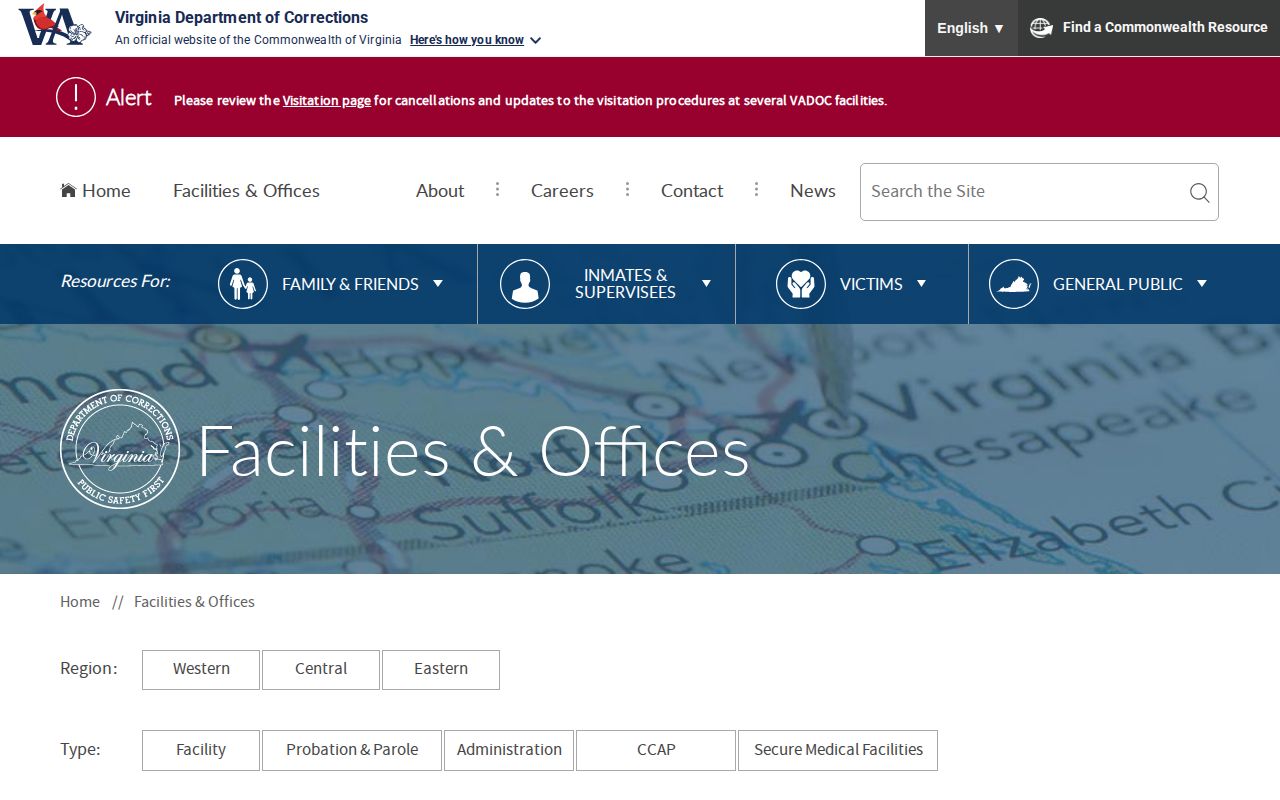
The directory result helps distinguish a Lynchburg supervision address from an Amherst jail location. Officials and assignments can change, so use the live entry before travel.
VADOC District 13
2209 Florida Avenue
Lynchburg, VA 24501
Phone: 434-947-6651
Service area: Amherst, Campbell, Nelson, and Lynchburg
Amherst Supervision Violations and Warrants
Conditions are the rules written into a probation or parole document. They may require reporting, lawful conduct, or compliance with case-specific directions. The exact signed paper controls. A suspected breach does not automatically prove a new conviction. If a probation officer alleges a violation, the matter returns to the sentencing court. A parole violation can lead to revocation proceedings under the Board's authority.
No official Amherst County page was found that publishes a complete probation or parole absconder list. VADOC's public most-wanted material is also not a full Amherst supervision roll. An absconder label means the agency alleges the person is no longer available to supervision. Verify that claim through the VADOC status, an Amherst court docket, and any official warrant information the responsible office will provide.
Virginia Jail VINE concerns local or regional jail custody events, not routine community-supervision changes. VADOC's separate NAAVI service provides eligible victim notices for state-custody events. Neither system should be described as a public list of all Amherst probationers or parolees.
A warrant and a supervision entry also answer different questions. A VADOC record may show an assigned district while a court docket shows an alleged violation. Neither one alone proves that a warrant remains active at the moment of the search. Review the newest docket event, compare the identity and case number, and seek confirmation from the agency responsible for the warrant. If the issue concerns probation, the sentencing court controls the violation case. If it concerns parole, the Board and VADOC records document the state process. This layered check avoids treating an allegation as a conviction or an old public entry as a current command.
Conditions end only through the lawful discharge or modification process. A move between officers or districts is not discharge. Nor does a jail stay automatically erase the prior supervision term. The current order, signed conditions, and VADOC status should be read together when Amherst custody overlaps with an older state-supervision case.
How Amherst Supervision Ends
Supervision ends by formal discharge, not merely because a person stops appearing in a public locator. A court record can show completion or alteration of probation. VADOC maintains the state supervision file and can identify the proper record route for parole or probation discharge. Fully discharged people may eventually stop appearing in the public locator, and VADOC makes no promise of indefinite public display.
A clean verification set identifies the precise system and event. Use BRRJA for the end of an ACADC booking, the court for the sentence and probation order, VADOC for active supervision or discharge, and the Parole Board for an eligible parole decision. Each answers a different question. A person can be out of jail, on probation, under parole conditions, or fully discharged, and those outcomes should never be collapsed into one loose use of the word released.
Note: No public result may reflect a spelling issue, an old record, a transfer, or completed supervision, so seek the originating record.
Amherst Parole Decisions and Dates
The Virginia Parole Board's public-meetings page is not a name-searchable schedule of every prisoner's interview. Correctional facilities receive quarterly interview schedules under Board policy, while public outcomes are published in monthly decision reports. The categories and timing are distinct. The public reports use the outcomes Grant and Not Grant. Individual decision status goes to the person and counsel rather than to any caller.
Eligibility also differs from release. Code § 53.1-151 contains varied thresholds for eligible sentences based on commitment history and other rules. Even after a grant, VADOC checks warrants, detainers, court orders, discipline issues, and uncalculated sentences before authorizing release. The decision report should therefore be paired with the current locator and actual release paperwork.
Amherst Release and Reentry Services
A state provider directory published in 2022 lists Virginia CARES as serving Amherst County and ACADC. A later Virginia legislative report said BRRJA itself had no formal reentry program in 2025. Both findings can be true. One identifies an outside provider documented as serving the jail, while the other describes the lack of a formal program run by the regional authority.
Service availability can change. Confirm the current program directly before relying on help with documents, transport, or other needs. Reentry support also does not prove parole, probation, or discharge status. Those facts remain matters for BRRJA, VADOC District 13, the sentencing court, or the Parole Board, depending on the custody path.
Amherst release planning may therefore involve several offices. BRRJA can address the jail record, an Amherst court can supply the controlling order, and District 13 can address state community supervision. Virginia CARES is a possible service connection, not a corrections decision-maker. Keeping those roles distinct prevents a service referral from being mistaken for legal status or a reporting assignment.